Most M&A deal models are built with discipline. Technology integration is scoped early. Legal exposure is mapped in detail. Operational synergies are modeled and tracked.
Brand is typically treated differently. It carries measurable weight in enterprise value, yet brand planning is routinely deferred until after close, well outside the deal model where every other major cost and risk assumption lives. This gap is rarely intentional. It is the product of how brand has historically been framed: as a creative challenge rather than a
financial one.
That framing is costly. Deal teams who have felt it know exactly where it shows up: in costs that surface after close, in timelines that compress under pressure, and in decisions made without the options that earlier planning would have preserved.
Brand shapes deal outcomes before and after close
Brand is a driver of how value is created, realized, and perceived by the market, making it one of an organization’s most important intangible assets. That distinction matters: a recent study found that intangible assets, including brands, now account for approximately 92% of S&P 500 market capitalization. Yet organizations still tend to evaluate brand decisions separately from core deal assumptions, even though they can materially influence integration costs, timing, customer experience, and long-term value realization.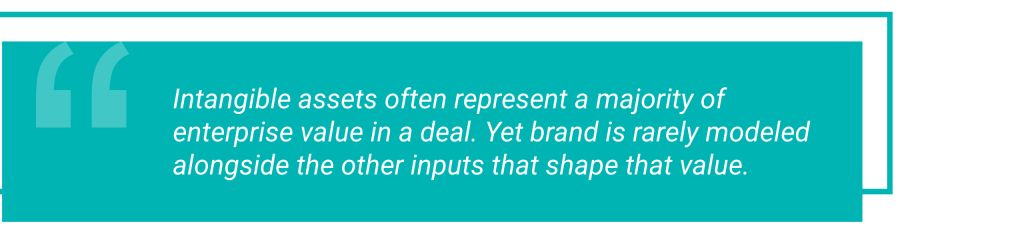
Why brand is still left out of early deal modeling
There are understandable reasons why brand rarely enters the deal model early. Brand can feel intangible or difficult to quantify before a strategy is finalized. Responsibility for brand often sits outside the core deal team. And with so much uncertainty in play, planning is deferred.
Deferral has a cost that tends to be invisible until it isn’t. When implementation planning starts after strategy is locked, teams discover the true scope of brand change under pressure such as incomplete asset inventories, vendor timelines that don’t fit the integration schedule, and budget assumptions built without real data. What follows is reactive spend: rushed procurement, off-cycle production, and rework that could have been avoided with a few weeks of structured planning earlier in the process.
The teams most affected are the ones who carry the weight of it later. This includes the IMO working against compressed timelines, the CMO defending budget assumptions that were never grounded in real scope, and the CFO absorbing brand-related costs that surfaced after close. And when brand decisions get pushed into execution without central coordination — delegated to regional teams or business units operating independently — inconsistencies compound. Customers encounter different names, outdated signage, and conflicting digital experiences across touchpoints, often during the exact moment the organization is trying to signal unity and stability. This is precisely why we advise marketing leaders on how to get ahead of this.
Where brand economics and operational reality meet
If brand contributes to value, then its implementation is how that value is realized or lost. Two dimensions shape that realization process.
The strategic dimension: This addresses how the brand approach supports growth, what it signals to the market, and how it positions the combined organization for the future.
The operational dimension: This addresses the actual work of execution, including which assets need to change, what it will cost, what can be delivered by Day 1, and how a global rollout will be sequenced.
Many organizations address these dimensions sequentially, and the logic feels sound in the moment. If the brand strategy isn’t finalized, how can implementation planning begin? What assets need to change if the architecture hasn’t been decided? These are reasonable questions, and they’re exactly what causes implementation to wait.
The problem is what happens during that wait. Strategic decisions get made without anyone modeling what they will cost to execute. Architecture choices that seem equivalent from a brand perspective can vary by millions of dollars in implementation complexity. And by the time implementation teams are brought in, the decisions are already locked, leaving execution to solve for constraints it had no hand in shaping. Timelines compress, options narrow, and the plan that gets built is the one that fits what’s left, not the one that would have been chosen with full information.
Parallel planning closes that gap by running both workstreams together. Implementation teams develop cost models and asset scope in real time as brand strategy takes shape, so each informs the other before commitments are made. A strategic choice about brand architecture becomes testable against what execution will actually require in time, cost, and operational complexity. The result is a funded, executable plan that moves directly into post-close execution rather than having to be rebuilt after close under pressure.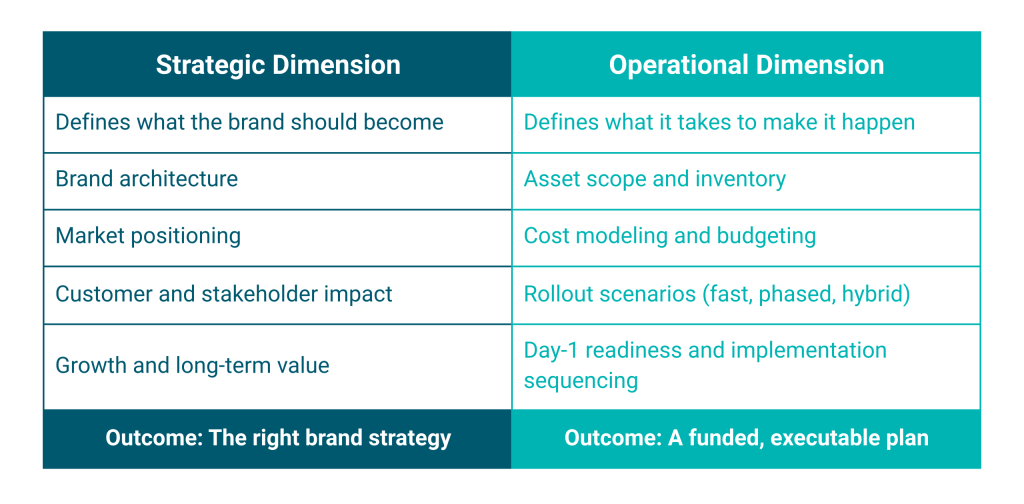
What parallel planning looks like in practice
Client example: Global manufacturing spin-off
When a major global manufacturer underwent a complex corporate separation, the organization faced a compressing set of demands: remove all legacy branding from thousands of assets across 150+ sites in 60 countries within 12 to 18 months, while simultaneously launching a new identity for the spun-off entity.
Before a name had even been finalized, BrandActive partnered with the Enterprise Strategic Marketing team to model two distinct rebrand scenarios. Each was modeled in detail, with cost forecasts broken down by CapEx vs. OpEx, geography, asset type, and resource requirements. It was the kind of scenario planning that gave leadership the information they needed to select a hybrid model: front-loading high-visibility legal
assets while phasing others over time.
The result was a unified global brand across more than 8,600 assets, with scalable governance built for future M&A and significant cost optimization through reduced vendor overlap.
The risk of separating strategy from execution
When brand strategy and implementation planning move in sequence rather than in parallel, the gap between them generates risk that compounds under deal timelines. Strategic decisions get made without full visibility into their operational implications, cost assumptions are built before scope is understood, and vendors are engaged after flexibility has already narrowed.
When brand planning starts early enough for strategy and implementation to stay aligned, the outcomes reflect it. When it doesn’t, the costs of that separation tend to surface in the same predictable places: budget overruns, compressed timelines, and rollouts that require rework.
Client results that show the difference
When four legacy healthcare systems merged into one, integration was underway in some areas and barely begun in others, yet detailed implementation planning had to move forward before the new brand identity had even been revealed internally. BrandActive developed asset plans, signage specifications, and technical guidelines in parallel with brand strategy still being operationalized, coordinating across five external agencies and using a pseudonym to keep planning on track without prematurely disclosing the identity. That early, parallel work is what made execution predictable: 99% of inventoried assets converted on time, $6.5M saved through smart sourcing, and the capital signage program delivered under budget.
During one of the largest bank mergers of its kind, the full complexity of brand change across a large, decentralized footprint had never been fully scoped or quantified before execution began. BrandActive modeled scenario-based options that made timing trade-offs and cost variation explicit, giving leadership the information needed to sequence and prioritize before commitments hardened. Regional sponsorship transitions that could have stretched across multiple fiscal cycles were largely completed within six months. Across the broader rebrand, the work delivered cost savings of 15 to 30 percent in high-visibility workstreams and efficiency gains of 20 to 30 percent enterprise-wide.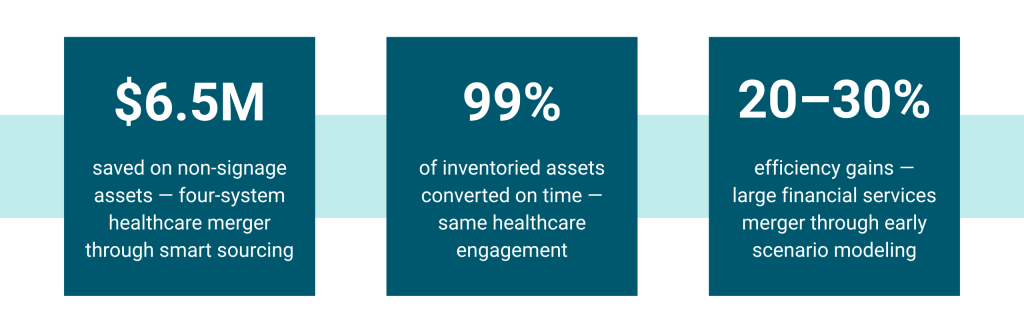
Brand due diligence: Bringing brand into the deal model
A more structured approach treats brand as an input to the deal, not an output of it. Brand due diligence brings together two perspectives.
Strategic evaluation: Usually led by your organization’s creative/brand strategy partner, this work focuses on how different brand approaches affect value, perception, growth potential, and risk.
Operational evaluation: Determining what it actually takes to deliver the chosen brand approach is our focus at BrandActive — from asset scope and cost modeling to rollout scenario comparison (fast, phased, hybrid) and Day-1 readiness planning. We’ve spent nearly 30 years supporting complex brand transitions driven by M&A.
Together, these inputs allow brand to be treated as a modeled component of the deal rather than a variable addressed after close. That shift changes what deal teams can see and what choices remain available to them.
Experience across complex rebrands reinforces why this matters at the deal economics level. When implementation costs are modeled early and scenarios are used to identify rationalization opportunities, one-time migration costs typically come in well below 2% of annual revenue, and under 1% when viewed against projected five-year revenue. Scenario modeling alone has surfaced cost rationalization opportunities of 15 to 25% in comparable engagements. The implication is significant: brand implementation costs are manageable and forecastable when they enter the deal model early. What makes them feel large is when they arrive unmodeled, after close, with limited flexibility to optimize.
What leading deal teams do differently
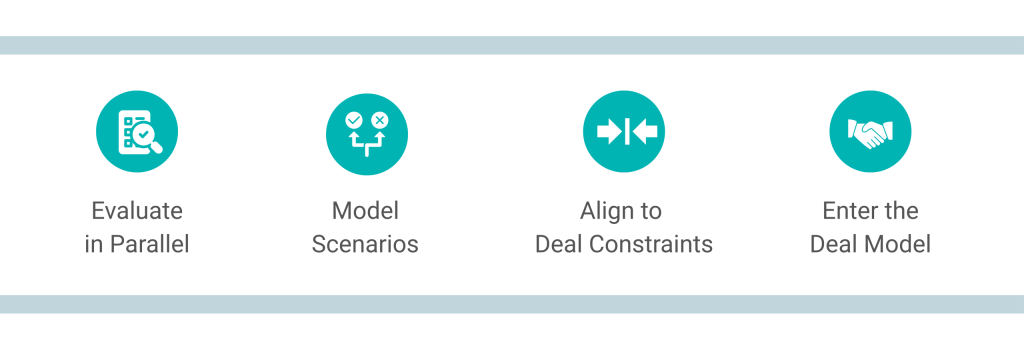
Organizations that incorporate brand into their deal models tend to take a consistent approach across four practices: they evaluate strategy and implementation in parallel; they model multiple scenarios before committing to a path; they align brand decisions with deal constraints; and they bring brand into the deal model itself as a line item with modeled cost ranges.
Client example: Vale
Following the acquisition of Vale Inco, BrandActive supported the global brand transition by establishing a centralized PMO to coordinate vendors, budgets, and asset conversion across a complex global portfolio — while planning for multiple brand scenarios simultaneously. Strong governance and disciplined execution controlled costs and maintained consistency at scale.
What this changes
The organizations that move fastest after close are the ones that did the planning before it. Early readiness aligns leadership around cost, timing, and trade-offs. Teams enter Day 1 with a funded plan instead of open questions.
But the value of that early alignment extends beyond logistics. Our experience and that of our partners across M&A-driven brand transitions consistently shows that how a brand is managed during a deal directly shapes how people experience the change. Employees look to the brand for signals about what the transition means for their role, their team, and their future in the combined organization. When those signals are unclear or inconsistent, engagement erodes. Customers watch for the same coherence, and any gap between what is being communicated and what they encounter across touchpoints creates doubt at exactly the moment trust needs to be reinforced. Investors and analysts read brand execution as a proxy for organizational control. A well-governed, consistently delivered brand transition tells the market that leadership has command of the integration. Ongoing stakeholder engagement — not just at launch, but through the full transition — is what sustains that confidence and turns a successful rebrand into lasting value.
From intangible cost to modeled input
Brand has often been treated as an outcome that follows the deal, something to figure out once the structure is confirmed. A growing number of deal teams are beginning to treat it differently: as an input evaluated alongside other factors that shape value, cost, and risk.
The practical starting point is clear: begin modeling before you commit.