
Many deals struggle to deliver their full potential because integration decisions are made too late in the process. When leaders think about integration risk, they typically focus on technology systems, data migration, talent retention, operational consolidation, and regulatory approvals. These are rightly seen as high-stakes workstreams.
What is often overlooked is that brand and marketing are also integration decisions. Brand is not simply an expression of the deal. It affects how assets are converted, how systems are renamed, how vendors are managed, and how quickly the combined organization can operate as one.
Decisions around naming, identity, and rollout carry real financial consequences. Without early planning, organizations underestimate the scale of branded asset conversion across digital platforms, physical environments, legal entities, contracts, and internal systems. Those costs surface after close, when flexibility is lowest and scrutiny is highest.
When brand decisions lack clarity early on, confidence erodes across critical audiences. Employees question what the change means for them. Customers hesitate as signals shift. Investors and analysts look for signs of operational control. Delays, rework, and reactive spend have direct implications for deal momentum and value realization.
When marketing is engaged before close, leaders gain early clarity on the issues that matter most:
- How brand scope and costs should be modeled into the deal. Early asset scoping and scenario modeling help teams forecast investment accurately and avoid post-close surprises.
- Where trust is most at risk. Clear brand planning protects confidence among employees and customers during transition.
- Which assets truly need to change, and when. Prioritization reveals opportunities to phase, consolidate, or retire assets rather than replace everything at once.
- How brand timing intersects with regulatory, capital, and operational constraints. Early alignment prevents downstream delays.
This is why early marketing involvement consistently reduces surprises, shortens timelines, and lowers total integration cost.
The CMO’s moment to lead during M&A
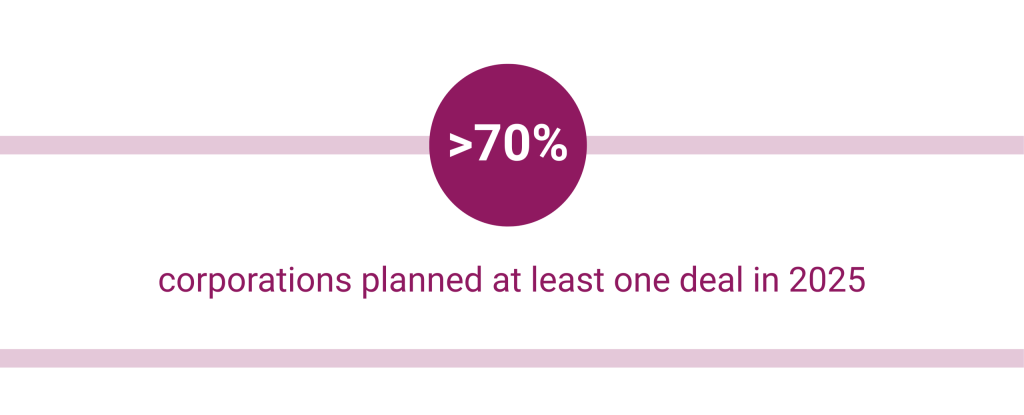
M&A creates a rare leadership window for CMOs. According to KPMG, more than 70 percent of corporations planned at least one deal in 2025, underscoring sustained deal momentum and rising expectations for integration execution. As activity extends into 2026, integration excellence is emerging as a competitive differentiator rather than a baseline requirement.
In steady-state environments, marketing’s contribution to enterprise value is often distributed across brand, demand, and experience initiatives, making direct financial attribution difficult. During a transaction, that impact becomes clearer and more immediate. Brand decisions directly affect integration costs, speed to alignment, employee confidence, customer retention, and how decisively the organization shows up to the market.
Scenario modeling is a key driver of this impact. It involves evaluating multiple brand integration approaches based on timing, cost, operational complexity, and risk. Teams model fast, phased, and hybrid scenarios to understand how different decisions affect capital spend, operating budgets, and execution timelines.
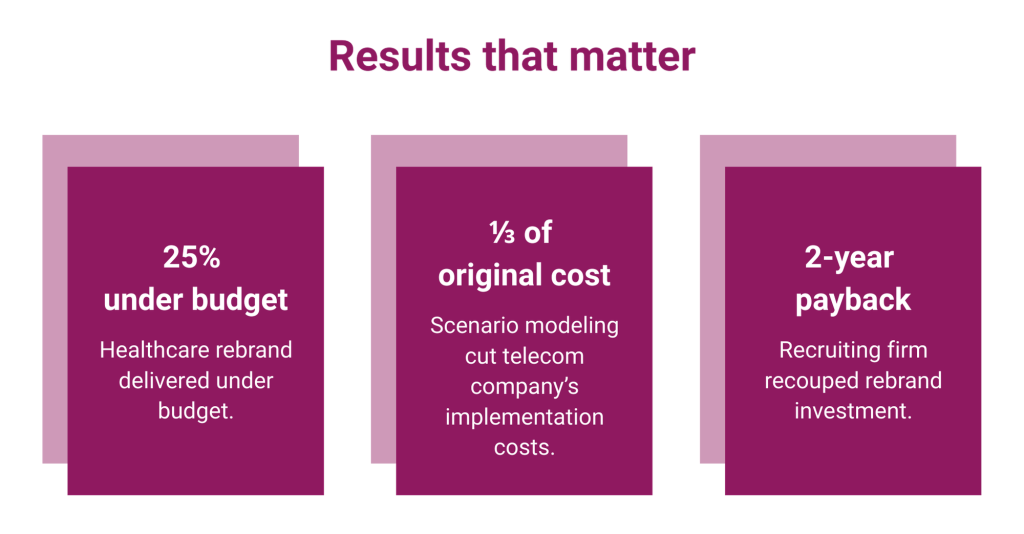
We have seen this discipline change outcomes. In a large telecommunications acquisition, early scenario modeling reduced projected rebrand implementation costs to roughly one-third of the original estimate by identifying which assets needed to change at close and which could follow later. In another engagement with a global recruiting firm, a phased rollout aligned to operational cycles enabled the organization to recover its rebrand investment within two years.
These outcomes were driven by clarity and control: clear asset inventories, multiple cost and timing scenarios, and governance aligned to the scale of change. When marketing leads with data and options, trust follows.
This is how CMOs move from being consulted to being relied upon.
Why waiting creates risk in M&A
During transactions, teams often hesitate to engage brand planning early due to uncertainty around deal structure, regulatory timing, and concern about doing work that may need to change once the deal is finalized.
Early planning focuses on understanding scope and preparing for multiple outcomes. It does not require final brand decisions or regulatory approval. What it does is provide the foundation leaders need to make informed choices when timing accelerates.
Teams that start early are able to:
- Understand the true scale of brand change across the organization
- Develop multiple integration paths instead of a single, fragile plan
- Build credible budgets and timelines
- Align with the Integration Management Office before decisions harden
- Reduce pressure-driven tradeoffs late in the process
Decisions made early are almost always less expensive than those made under time constraints. This is where marketing protects deal economics.
Four things marketing leaders should do before close
If the goal is to protect value and reduce risk, four actions matter most before a deal closes.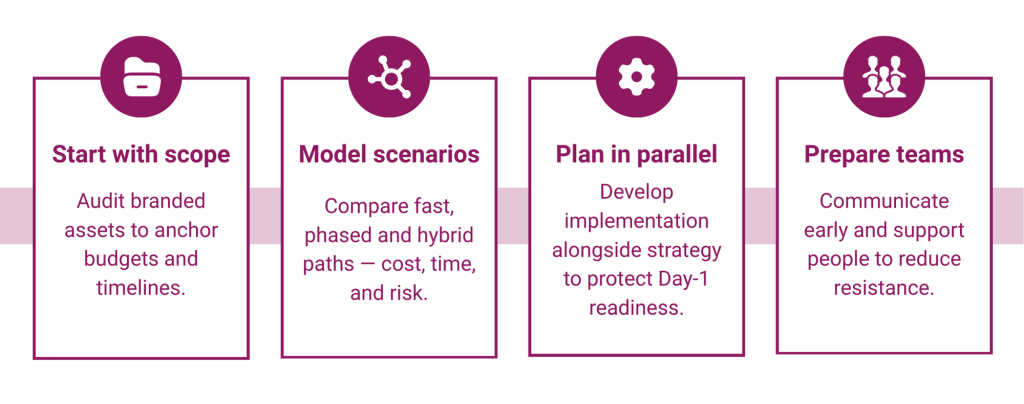
1. Start with scope, not aesthetics
Before debating names or visual systems, build a clear view of what exists today. A structured branded asset audit reveals scale, duplication, and opportunities to retire or phase assets rather than replace everything at once. This clarity anchors realistic budgets, timelines, and expectations across the deal team.
2. Build scenarios, not a single plan
Executives need informed choices. Develop multiple rollout scenarios that vary by speed, cost, brand impact, and change approach—whether full conversion, endorsement, or another transition model. Show how each option affects capital expenditure, operating budgets, execution risk, and time to market. This positions marketing as a strategic advisor who understands tradeoffs, not a downstream executor.
3. Plan implementation in parallel with brand strategy
Implementation planning should move alongside brand strategy so teams can manage constraints, protect timelines, and control costs as decisions evolve.
In our brand change done right webinar, leaders from Pfizer and Allspring Global Investments highlighted how early implementation planning preserved momentum under pressure. At Pfizer, early expertise enabled comprehensive asset accounting and multiple budget scenarios as priorities shifted. At Allspring, parallel planning supported a two-phase separation from Wells Fargo Asset Management, meeting a nine-month legal deadline before returning to quality and long-term brand experience.
In regulated or time-bound environments, this discipline helps teams stay on track and avoid costly delays.
4. Prepare people for change
M&A-driven rebrands place significant strain on internal teams. People are asked to adopt new identities, processes, and ways of working while maintaining performance.
Clear communication, realistic pacing, and visible support help reduce resistance and confusion. Both Pfizer and Allspring emphasized the importance of celebrating milestones, supporting teams with external help when needed, and reinforcing pride in the new brand through tangible actions.
When employees feel supported through transition, adoption improves and the brand shows up more consistently for customers and the market.
How marketing proves ROI during M&A
The most effective marketing leaders translate brand decisions into business outcomes. Client results reinforce this connection. When one of our clients unified three distinct healthcare systems under a single brand, disciplined planning and prioritization helped deliver the rebrand approximately 25 percent under budget. In another large financial services merger, the client needed to rebrand more than 25,000 assets across 14 business lines. Through comprehensive asset audits, vendor coordination, and phased execution, the rollout was completed on time while saving millions of dollars through asset rationalization and prioritization.
ROI models, cost savings, and payback scenarios help leadership see brand integration as a managed investment rather than an open-ended cost. Phasing, prioritization, and sequencing preserve impact while reducing unnecessary spend.
When executives see marketing managing complexity with financial discipline, credibility is reinforced.
Moving forward with clarity
When early planning is delayed, organizations pay for it later through rushed decisions, higher costs, and lost confidence at the moment scrutiny is highest.
Over the past 27 years, we have supported more than 1,100 rebrand projects, many driven by mergers and acquisitions. The pattern is consistent: when brand integration is modeled early, organizations protect value and execute with greater confidence once transactions are announced.
This is why our M&A work often begins with a pre-close brand integration readiness and cost scoping engagement.
Conducted over a focused six- to ten-week window, this work helps teams:
- Scope branded assets and key cost drivers
- Model fast, phased, and hybrid integration scenarios
- Understand timing, sequencing, governance, and risk
- Align on a funded, executable plan that transitions directly into post-close execution
If an M&A is on your horizon, the most valuable work may be the work you start now.
Ready to explore your options? A short conversation can bring clarity to what is coming, what it will take, and where opportunity exists.