Most organizations walk into a rebrand thinking the hard part is strategy. Pick the new name, finalize the logo, approve the visual system. Then you execute.
For manufacturers and industrial, medical device, and life sciences organizations, that assumption is expensive. Because once the brand is finalized, the complexity escalates, and a significant portion of it lives in your packaging and labels.
This is more an operational problem than a marketing one. And if it is not on your radar before the transition starts, it will find its way onto your radar through missed timelines, regulatory holds, and cost overruns (potentially in millions of dollars) that nobody budgeted for.
Why packaging and labels get underestimated in rebrands
Unlike a website or a sales deck, packaging and labels are embedded in your supply chain, your regulatory filings, and your ERP systems. Updating them requires coordinating across design, compliance, procurement, and systems.
Here is where organizations typically hit the wall:
Your product list is incomplete (and you may not know it)
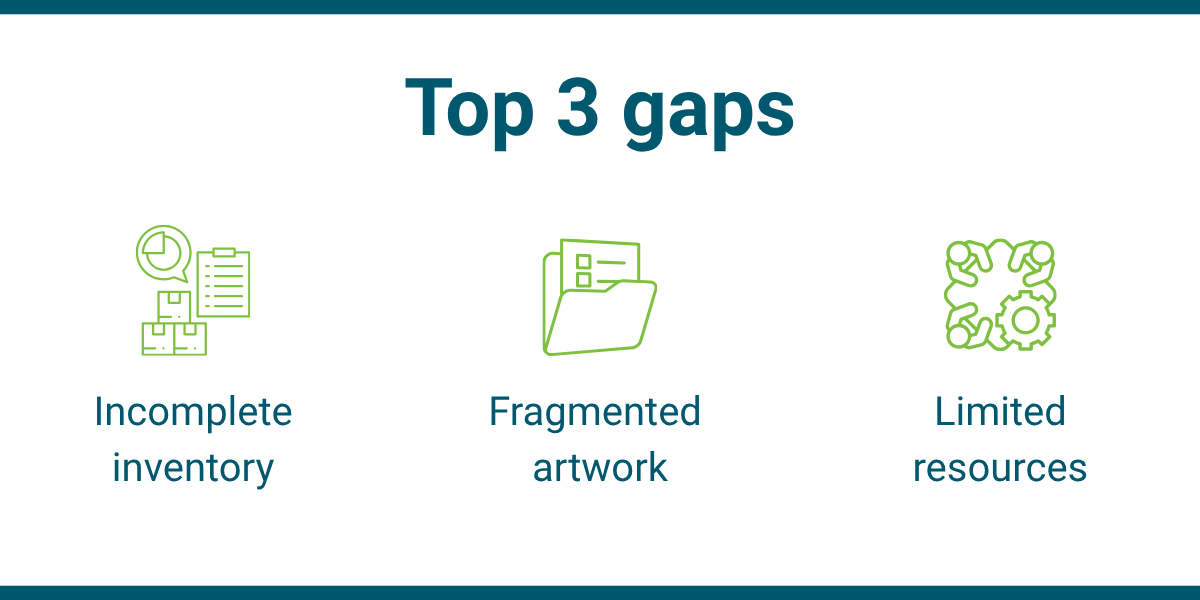
Ask most manufacturers for a complete list of their products and packaging components, and the number they give you is a confident estimate, not a verified count. Products sold across regions, under different legal entities, and through OEM partners each introduce their own gaps. What looks like a tidy internal list often turns out to be a starting point. In practice, some files live with vendors, some are stored at plants, and others exist on local hard drives that the central team does not know about.
Your artwork files are scattered (and probably out of date)
Knowing what products you have is one problem. Knowing where the approved, current files for those products live is another. Most organizations do not have a central repository for packaging artwork, and the files that do exist are not always the right version. Some have been updated locally by a plant or vendor without going through a formal approval process. Others are sitting in an agency’s archive from a project completed years ago. By the time you track down what you need, reconcile versions, and confirm what is actually approved, weeks have passed before a single label has been updated.
Teams built for steady state, not overhaul
Most packaging teams are sized to handle a manageable flow of new products and updates each year, not run an organization-wide transition at the same time. Without a dedicated program structure, something gives.
What makes packaging and labels harder in your industry
For CPG or retail brands, packaging is marketing-led and regularly refreshed. Processes exist and teams know the cadence. For manufacturers in advanced manufacturing, medical devices, life sciences, and specialty chemicals, the dynamic is different.
Packaging in these sectors is functional, not marketing driven. It may not change for years. When a rebrand is triggered — most often by a spin-off, merger, or acquisition — no one has a practiced playbook for a portfolio-wide transition of this scale.
A few factors that compound the complexity:
- High SKU counts across global markets. One product family can have dozens of SKUs, sold across multiple regions, under different legal entity names, with packaging reflecting local language, regulatory requirements, and certifications. Each touchpoint needs to be inventoried, assessed, and updated.
- Multiple stakeholder groups with competing timelines. Updating a label involves packaging engineers, product managers, supply chain, regulatory affairs, legal, quality assurance, and often plants and OEM partners. Each group has its own review cycle, and misalignment between them can stall an entire product family.
- Regulatory requirements that vary by country. In med device and life sciences especially, packaging changes can trigger recertification requirements. Filing timelines vary by regulatory body with the FDA, Health Canada, EMA, PMDA, and others each having their own processes. Regulatory filing costs alone can reach approximately $10,000 per filing per country, not including any testing or recertification triggered by a product change.
- Production cycle timing. Some packaging components are produced monthly. Others run on multi-year cycles. If your transition timeline does not account for those cycles, you face a choice between scrapping existing inventory or running old and new packaging in the market simultaneously, and either option carries real cost. Scrapping materials at scale can run into the millions.
| Complexity factor | Downstream risk if not managed |
|---|---|
|
High SKU volume across global markets |
Missed touchpoints result in non-compliant or inconsistent packaging reaching market. |
|
Multiple stakeholder groups with competing timelines |
One group’s delay stalls an entire product family. |
|
Regulatory requirements that vary by country |
~$10K per filing per country
Packaging changes can trigger recertification — before testing costs are factored in. |
|
Production cycle timing |
Scrap costs in the millions
Misaligned timelines force a choice between scrapping inventory or running old and new packaging simultaneously. |
Risks and costs to account for before you start
Getting ahead of packaging and labels means planning for both the operational risks and the financial exposure. They tend to show up together, and the costs can be significant. Tool replacement alone can range from $500 to $150,000 per unit. Scrapping inventory at scale can reach millions. Regulatory filings run approximately $10,000 per filing per country. Here is where that exposure typically originates:
- Artwork and content variability. It is easy to assume a product family shares consistent packaging content. In practice, variants, regional editions, and locally adapted versions can multiply the number of unique assets significantly. When teams estimate rather than inventory, scope gets set against the wrong number, and the gap surfaces mid-transition when there is no good time to absorb it.
- Partner and distribution gaps. Organizations often assume their distribution network is being updated centrally. In practice, some regional partners may be working from PDFs or outdated files that were never connected to the central system.
- Excess inventory you do not track. Products no longer actively sold but still sitting in warehouses or at third-party distributors are easy to overlook, but they matter for two reasons. First, storing obsolete inventory has a real cost: warehouse space, carrying costs, and the operational overhead of managing stock that will never ship. Second, if those products are identified early enough, a planned depletion strategy can avoid the need to scrap them entirely. Finding them mid-transition removes that option.
- Multiple ERP systems holding packaging data. Organizations that have grown through acquisitions often have legacy systems that were never consolidated. Artwork, SKUs, and brand hierarchies stored across those systems need to be aligned before the transition can move forward cleanly.
On the financial side, vendor and distribution costs are often the hardest to predict because quantities held by third parties are difficult to know until you ask. Building in a buffer for the unknown is one of the more practical things you can do before the work begins.
What a well-managed transition looks like
The organizations that move fastest and spend the least on packaging transitions are the ones that build structure before the work starts.

Start with a full portfolio inventory
Before scope, budget, or timeline can be set realistically, you need a complete picture of what exists across vendors, plants, partner portals, and regional teams. The inventory should capture asset type, location, owner, regulatory status, production cycle, and legal entity mapping. What you find will shape every decision that follows.

Map stakeholders and define the process
A packaging transition touches more groups than most organizations plan for. Defining who is responsible for what at which stage prevents the bottlenecks that slow artwork reviews, approvals, and regulatory filings. Roles will shift throughout the program as different phases require different involvement.

Define a conversion strategy before production begins
Not every product needs to transition on the same schedule. Prioritization based on production cycles, market visibility, and existing inventory levels helps sequence the rollout in a way that minimizes cost and disruption. A deplete-and-replace approach often makes more sense than scrapping, but it needs to be planned.

Build a program structure that can absorb the volume
Individual project management is not enough at this scale. A portfolio-wide transition requires a program layer that tracks progress across product families, flags risks early, and coordinates across all stakeholder groups, not one managed through email threads and shared spreadsheets.
A note on where to start
We have worked on packaging and label transitions with global manufacturers across med device, life sciences, and advanced manufacturing — including organizations navigating spin-offs and post-merger integrations. The pattern is consistent: the teams that plan inventory and program structure before the transition launches spend less, move faster, and encounter fewer surprises.
If packaging and labels are part of your product portfolio and a rebrand is on the horizon, starting with a structured inventory and planning engagement gives you a realistic picture of scope, cost, and sequencing before commitments are made.
Ready to understand what this looks like for your organization? Contact Jennifer Farrelly (j.farrelly@brandactive.com)