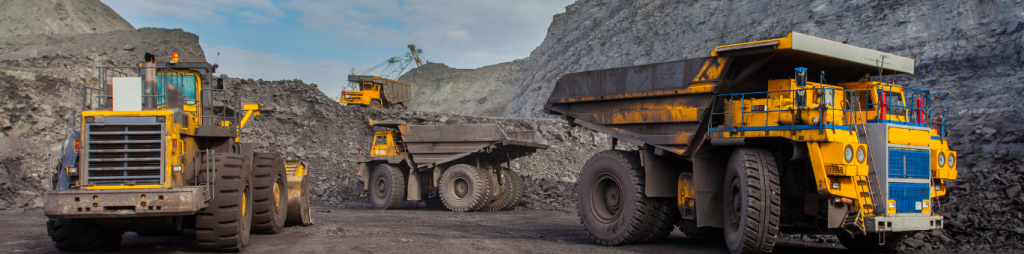
In mining, a rebrand is never cosmetic. It is operational, visible, and high-stakes.
When mining companies rebrand, often after an acquisition, merger, or strategic shift, the change hits the ground immediately. Assets are physical. Environments are hazardous. Teams are distributed across remote sites, countries, and regulatory regimes.
The difference between a successful rebrand and an expensive distraction shows up in execution discipline long before creative decisions matter.
We unpack the realities that make mining rebrands uniquely complex, and the hard-earned lessons BrandActive has learned supporting global transitions for some of the world’s largest mining companies.
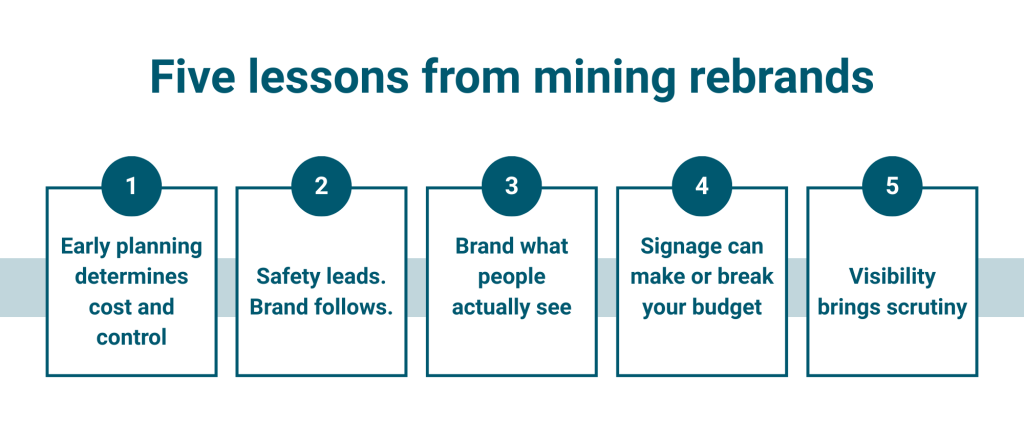
Lesson 1: Early planning determines cost and control
In mining, brand change runs straight into fixed realities such as production schedules, safety protocols, procurement cycles, and remote-site logistics. Once those are in motion, flexibility drops quickly. Mining rebrands that stay on track typically begin implementation planning six to nine months before a change goes public.
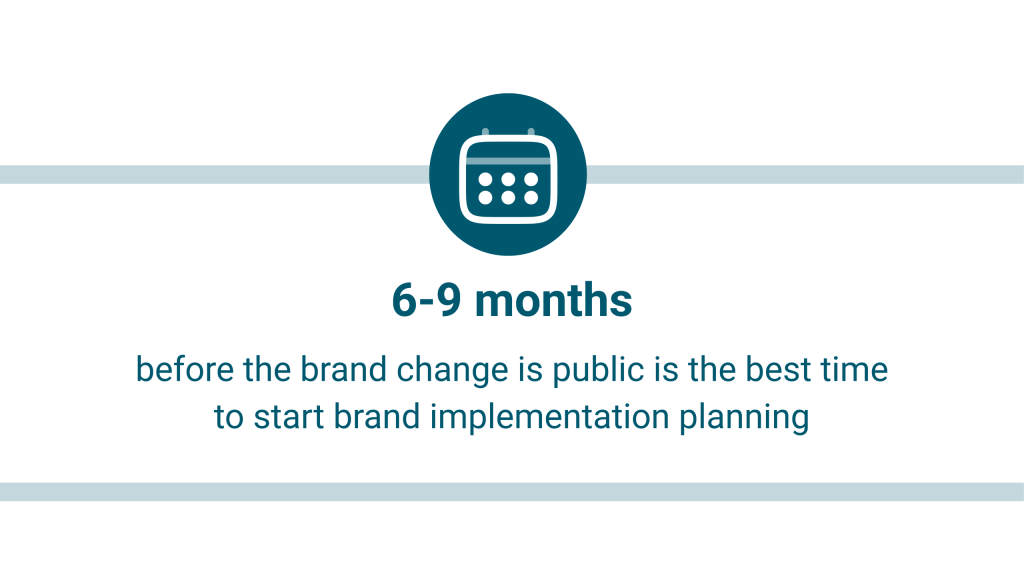
That window creates visibility. Leaders can see what is actually in scope before commitments are made.
Early planning allows teams to:
- Understand the true scale and cost of change across sites and asset categories
- Align Operations, EH&S, Procurement, Marketing, and Legal before decisions harden
- Build timelines that reflect vendor lead times and site constraints
- Make deliberate trade-offs while options are still available
When planning starts too close to launch, control shifts. Vendors are locked in, workarounds multiply, and costs surface late, when flexibility is already reduced.
Lesson 2: Safety leads. Brand follows.
In mining, brand decisions intersect directly with safety requirements. Asset choices reflect visibility, regulation, working conditions, and site-specific risk. That intersection becomes clear when guidelines move into the field. Even something as familiar as a hard hat carries operational implications.
During Vale’s global rebrand, helmet color could not be standardized globally. In snowy environments like Newfoundland, white hard hats reduced visibility and increased risk. The shift to high-visibility yellow followed site conditions and EH&S requirements, with logo applications adapted accordingly.
What appeared to be a narrow branding choice required coordination across EH&S, procurement, manufacturing, distribution, and disposal. The outcome strengthened trust with frontline teams and reinforced safety as a defining input to the brand.
Lesson 3: Brand what people actually see
Once assets leave the brand plan and enter a mining environment, their impact changes. Fleet vehicles illustrate this well. Fully branded fleets appear comprehensive during planning. In operation, underground equipment or vehicles permanently coated in dust and mud deliver limited visibility.
Mining rebrands that hold up over time focus brand investment where it will be noticed and remembered, while simplifying effort elsewhere.
That often means:
- Prioritizing assets visible to communities, partners, and regulators
- Reducing effort on short-life or low-visibility equipment
- Redirecting budget toward touchpoints that reinforce credibility outside the fence line
Lesson 4: Signage can make or break your budget
Across mining portfolios, signage supports safety communication, wayfinding, regulatory clarity, and brand presence. Decisions made site by site tend to compound cost. System-level decisions change the economics.
When Alcan rebranded across 138 sites in 30 countries, BrandActive helped redesign signage as a system rather than a series of replacements. The work included site audits, system rationalization, material specification, supplier RFPs, and industrial design.
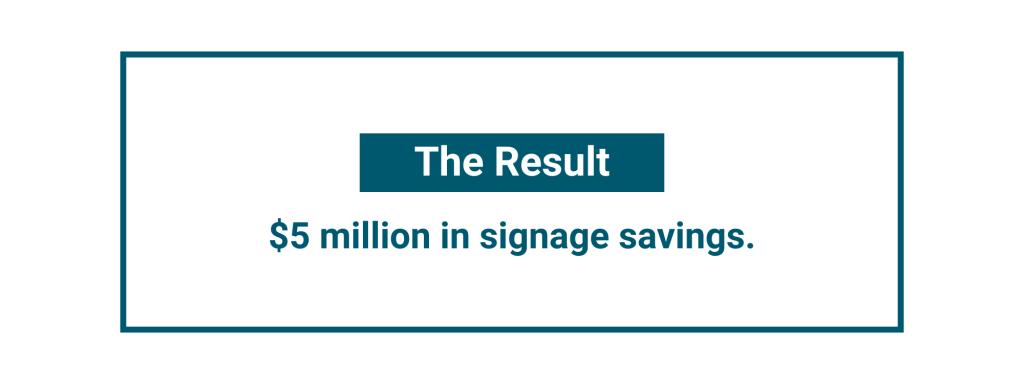
The result was $5 million in signage savings, achieved while improving consistency and reinforcing aluminum as a core brand material.
Lesson 5: Visibility brings scrutiny
Large mining acquisitions alter perception quickly. A newly combined or renamed company draws closer attention from regulators, host communities, employees, and investors. Small inconsistencies begin to signal discipline and credibility.
We have seen similar dynamics in other high-stakes environments outside of mining, including Pfizer’s rebrand during the COVID vaccine rollout. The organizations that succeed focus first on the assets that signal credibility and alignment, then scale from there.
In moments of heightened visibility, what you change first matters more than how much you change.
The throughline: Execution is the brand
The mining rebrands that succeed do not treat implementation as a downstream task, but an actual operational discipline.
That discipline shows up through:
- Clear understanding of scope before public commitments are made
- Cost and timeline modeling that supports executive decisions
- Governance that spans regions, functions, and vendors
- Sequenced rollouts that protect production and safety
BrandActive’s role is to help mining organizations get ahead of complexity so the brand shows up consistently, safely, and credibly where it matters most. If you are early in your thinking, that is the moment where the most value can still be protected. If you have questions about your mining rebrand, Let’s Talk.