
Many multi-brand companies eventually face the same strategic question: should we consolidate our brands?
For companies that have grown through acquisitions or operate across multiple product lines, brand portfolios often become complex over time. While consolidating brands under a single master brand can create market clarity and strengthen positioning, it typically requires far more than a marketing change.
This article explores when brand consolidation makes sense, what operational realities shape the decision, and how organizations evaluate a move toward a branded house model.
House of brands vs branded house: Understanding brand architecture models
Before deciding whether to consolidate brands, organizations first need to understand the main types of brand architecture strategy.
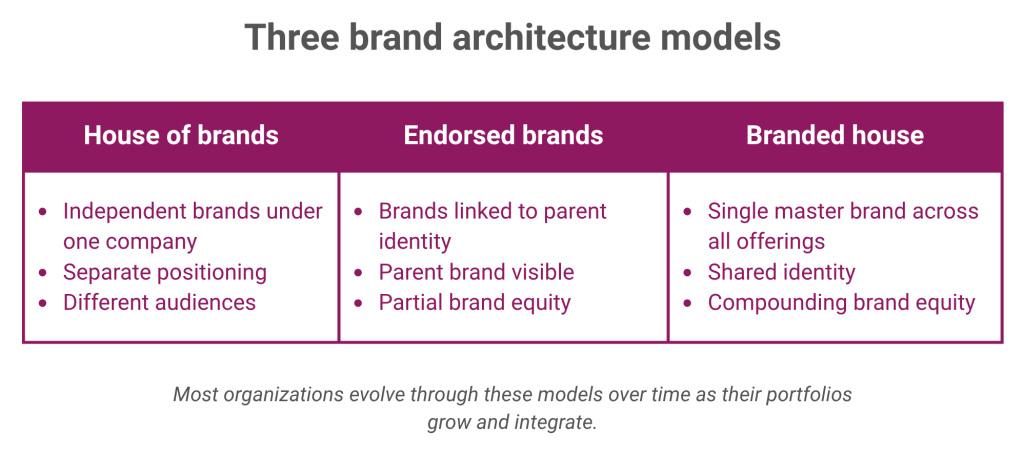
Most companies operate within one of three common models.
House of brands
In a house of brands, each product or business operates as an independent brand with its own identity, positioning, and marketing strategy. Customers may not realize the brands share the same parent company.
Examples include:
- Procter & Gamble
- Unilever
- Yum! Brands
This model works well when brands target different customer segments or require distinct positioning.
Endorsed brands
An endorsed brand architecture sits between independence and consolidation. Individual brands maintain their identities but are visibly connected to a parent company.
Examples include:
- Marriott hotel brands
- Nestlé product brands
This approach allows organizations to maintain brand equity while still leveraging the credibility of a parent brand.
Branded house
In a branded house, all products and services operate under a single master brand.
Examples include:
- FedEx
- Virgin
- Salesforce
This structure concentrates brand investment around one identity, strengthening brand equity and simplifying portfolio storytelling.
However, moving to a branded house model often requires significant organizational alignment, which is why companies carefully evaluate the operational implications before making the transition.
Why multi-brand companies consider brand consolidation
For many organizations, brand complexity builds gradually. Growth introduces new identities. Acquisitions add legacy brands. Product lines evolve into standalone offerings. Regional divisions develop their own presence in the market.
This dynamic is especially common among multi-product manufacturers, industrial companies, and portfolio-based organizations where different brands serve different customers, channels, or geographies.
Over time, leadership teams begin asking an important question: does our brand architecture strategy still support how we want to compete?
Common signals include:
- Customers struggling to understand how brands relate
- Marketing investment diluted across multiple identities
- Difficulty cross-selling across business units
- Overlapping brand narratives following acquisitions
At that point, the idea of consolidating brands often begins to surface. A branded house can create stronger market clarity, concentrate brand investment around a single identity, simplify portfolio storytelling, and allow commercial teams to represent a broader portfolio under one unified brand promise. But the strategic case is only one part of the equation.
Brand consolidation often starts as a brand discussion, but becomes an operational one
In BrandActive’s work with a global industrial technology company, this shift became clear early in the process. The organization had built a portfolio of brands over years of acquisitions, each serving different market segments and regions. On the surface, the strategic case for moving toward a unified master brand was compelling.
However, early discovery revealed a deeper reality. Many of the brands were operating with their own marketing systems, product naming structures, websites and digital platforms, partner programs, and operational processes.
What started as a brand architecture discussion quickly expanded into a broader enterprise integration conversation.
This pattern is common. Moving to a branded house is not simply a branding decision. In many organizations, it becomes an operational transformation with a brand outcome. For organizations navigating this as part of a merger or acquisition, early marketing involvement is what separates a smooth transition from a costly one.
Where brand consolidation impacts the organization
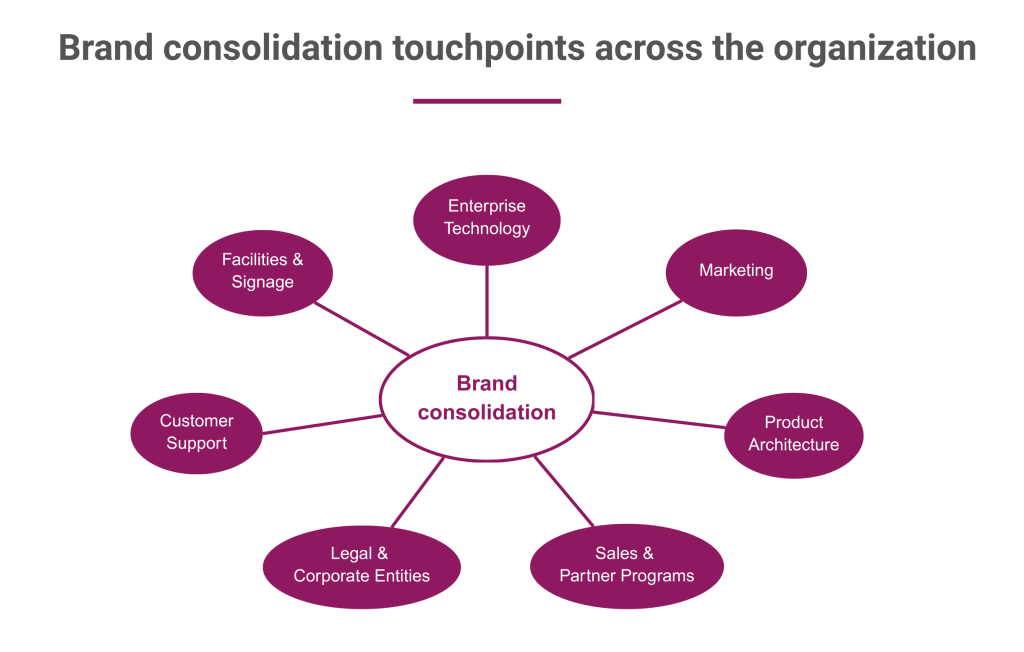
When organizations begin evaluating a branded house model, one of the most important questions leadership teams should ask is: Which parts of the organization will this change affect?
In most cases, the answer is nearly every major function.
Marketing and brand systems
Websites, brand guidelines, marketing assets, campaign platforms, and templates must align with the new master brand. Large portfolios may involve thousands of digital assets requiring migration or redesign.
Product architecture and naming
In many multi-brand companies, brand names are embedded directly into product families, SKU structures, packaging, and documentation. Brand consolidation may require reorganizing product hierarchies and renaming product lines.
Channel sales and partner programs
Sub-brands frequently maintain separate partner ecosystems, reseller agreements, portals, and training materials. Consolidation may require merging programs and updating contracts.
Customer support and service
Support infrastructure often mirrors brand structures. A unified brand may require integrating knowledge bases, service portals, and support workflows.
Facilities and physical environments
Office signage, factories, vehicles, showrooms, and wayfinding systems often reflect legacy brands. Global organizations may have hundreds of locations and thousands of branded assets tied to older identities.
Legal and corporate structure
Brand names are frequently tied to trademarks, legal entities, contracts, and regulatory filings. Consolidation may trigger updates across jurisdictions.
IT and enterprise systems
Sub-brands often operate separate CRM platforms, ERP systems, authentication environments, and digital infrastructure. Technology integration is often a major dependency before brand consolidation can occur.
The operational dependencies that shape brand consolidation
Once leadership understands the organizational impact, timing becomes the next question. In many organizations, brand portfolio integration must align with broader enterprise initiatives already underway.
Common dependencies include product architecture decisions, ERP or enterprise system migrations, legal entity updates, customer and partner contract changes, and organizational restructuring.
In BrandActive’s engagement with the industrial technology company mentioned earlier, these dependencies surfaced quickly during discovery. Product architecture and enterprise systems initiatives were already underway across the organization. Rather than treating brand consolidation as a standalone effort, leadership began exploring how the brand transition could align with those broader initiatives. This coordination helped reduce duplication and ensured the brand strategy supported operational transformation already in motion.
For a closer look at how phased planning reduces integration risk, see why scenario planning drives better decisions.
Change management and internal alignment
Operational dependencies are not the only forces that shape timing. In organizations where brands carry strong internal identity, particularly in businesses built through acquisition, leadership alignment and change management are strategic prerequisites.
Employees often identify deeply with the brand they were hired under. For teams in acquired businesses with strong legacy cultures, a brand transition can feel like a loss of identity before it feels like an opportunity. This dynamic rarely surfaces in a cost model, but left unaddressed, it can slow adoption, generate internal friction, and undermine the consistency a consolidated brand is meant to create.
Proactive internal communications, visible leadership alignment, and structured change management planning help organizations move through this transition with less disruption and more organizational buy-in. The brand strategy is only as strong as the people who carry it forward.
The real cost of consolidating multiple brands
One of the most common misconceptions about brand consolidation is that it’s primarily a marketing exercise. In reality, brand consolidation often resembles other enterprise transformation initiatives.
The scope can include:
- Signage replacement across facilities
- Packaging and product labeling updates
- Digital platform migrations
- Trademark and legal updates
- Product documentation changes
- Internal communications and change management
Across large portfolios, these changes multiply quickly.
In one BrandActive portfolio assessment, an organization initially estimated brand consolidation costs based primarily on marketing updates. But once the scope expanded to include packaging systems, digital platforms, legal documentation, and physical environments across multiple brands, the picture changed.
Preliminary modeling suggested a potential investment exceeding $22 million, excluding several technology initiatives already underway. The estimate didn’t determine the final decision. Instead, it helped leadership understand the true scale of change required and evaluate the investment alongside the strategic benefits of market positioning and brand
portfolio integration.
Managing brand equity risk during consolidation
Alongside operational cost and complexity, one concern comes up regularly when organizations evaluate brand consolidation: what happens to customer loyalty when a recognized sub-brand goes away?
This is a legitimate question, particularly when sub-brands have built strong recognition in a specific market, channel, or customer segment. Customers who have worked with a brand for years may feel disoriented when it disappears, especially if the transition is not communicated clearly or sequenced thoughtfully.
The risk of equity loss is real, but it is not prohibitive. Organizations that take the time to sequence the transition carefully and communicate proactively with key customer segments have successfully preserved loyalty through consolidation. The brands that struggle are typically those that treat the transition as an internal operational event rather than an external customer experience.
Practical approaches include endorsement periods (where both the legacy brand and the master brand appear together during the transition), targeted customer communications tied to key milestones, and sales and customer success enablement so frontline teams can speak to the change with confidence.

Two common approaches to brand portfolio integration
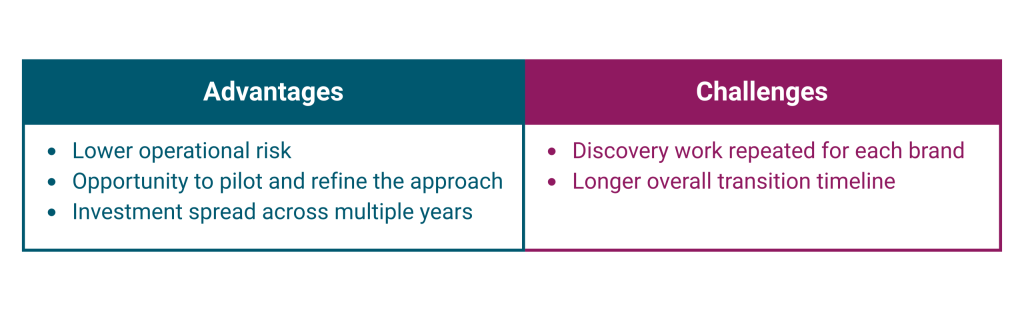
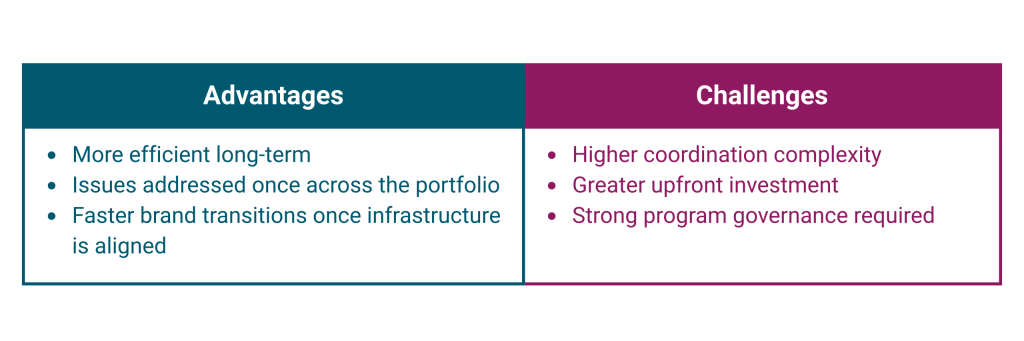
Organizations rarely consolidate all brands simultaneously. Instead, they typically adopt one of two approaches.
Brand-by-brand integration
Individual brands transition sequentially to the master brand.
Function-by-function integration
Key functions are standardized across brands first — such as marketing systems, legal structures, or facilities.
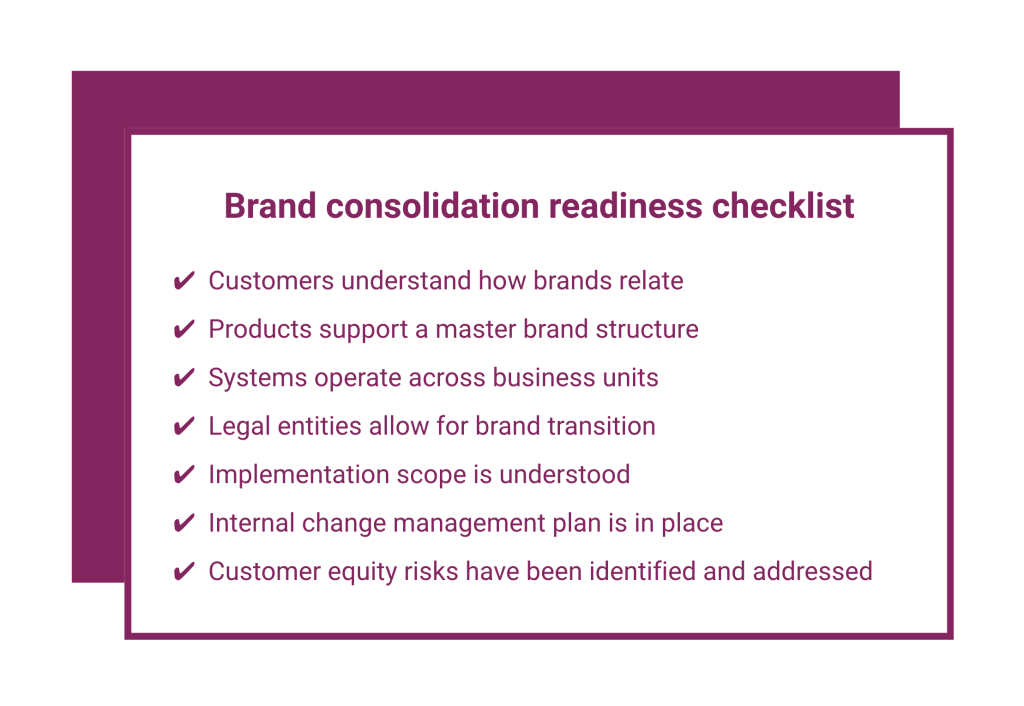
Brand consolidation checklist for leadership teams
If your organization is evaluating a move toward a branded house model, a structured assessment can clarify whether the timing is right.
Leadership teams should consider:
Market clarity
- Do customers understand how your brands relate?
- Is brand complexity affecting sales conversations?
Portfolio structure
- Are products and services organized in a way that supports a master brand?
Operational alignment
- Which systems and processes already operate across brands?
- Where are brands still operating independently?
Enterprise initiatives
- Are ERP migrations, system integrations, or restructuring projects underway that could align with brand consolidation?
Implementation scope
- How many assets, platforms, facilities, and legal entities would need to
transition?
Internal readiness
- Do acquired or legacy brands carry strong internal identity that will require active change management?
- Is leadership aligned on the brand narrative and prepared to communicate it consistently?
Customer equity
- Which sub-brands carry meaningful customer loyalty or market recognition?
- Is there a transition communication plan to preserve that equity through the change?
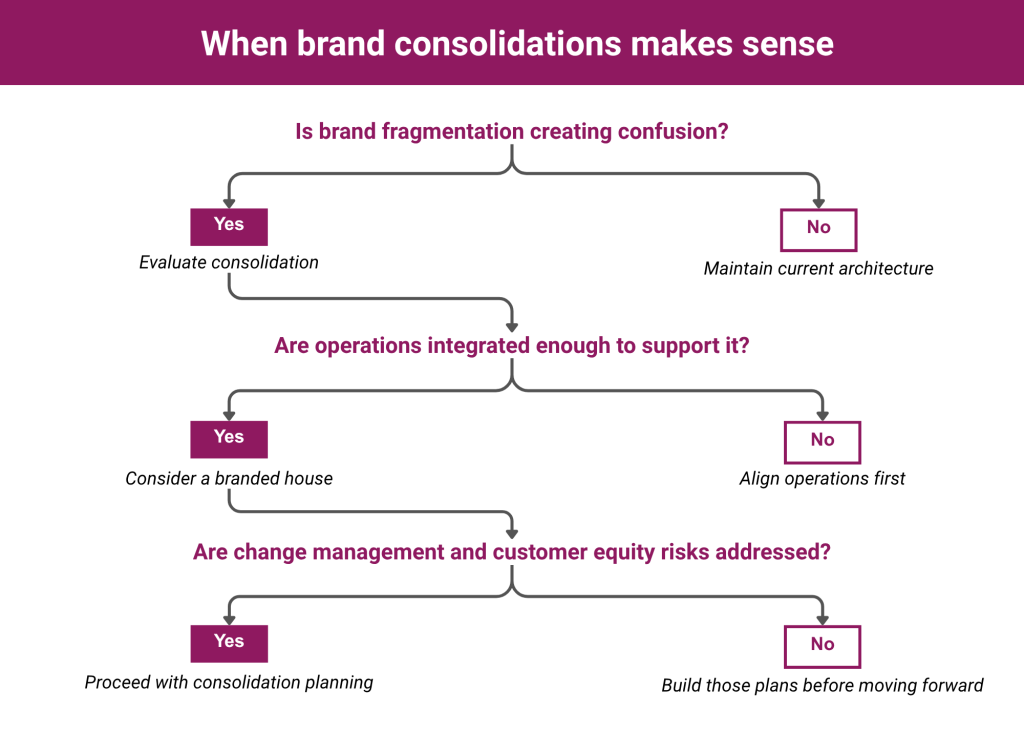
Answering these questions early helps organizations determine whether brand consolidation should happen now — or whether operational alignment should come first.
Brand architecture decisions require operational clarity
For multi-brand organizations, brand consolidation can unlock real strategic value.
It can strengthen brand equity, simplify market positioning, and make it easier for teams to represent the full business.
But the most successful brand architecture decisions are grounded in operational reality.
Sometimes the answer is move to a branded house now.
Sometimes it’s to phase the transition.
And sometimes the right answer is not yet.
What matters most is making the decision with a clear understanding of both the strategic upside and the operational implications.
Considering a branded house strategy?
Before consolidating your brands, it’s critical to understand the operational realities behind the decision.
BrandActive helps organizations evaluate brand architecture changes with a clear view of costs, dependencies, and implementation considerations — so leadership teams can move forward with confidence.
Talk to our team about your brand architecture strategy.