
Not every organization needs BrandActive.
If you’re leading a rebrand or brand integration, you already know this isn’t just a design project. It’s operational, financial, cross-functional and highly visible. Rebrand implementation—the process of translating brand strategy and design into reality across every asset, system and experience—is where the vision meets the day-to-day complexities of execution. One of your first decisions is also one of the most strategic: How will we get this done?
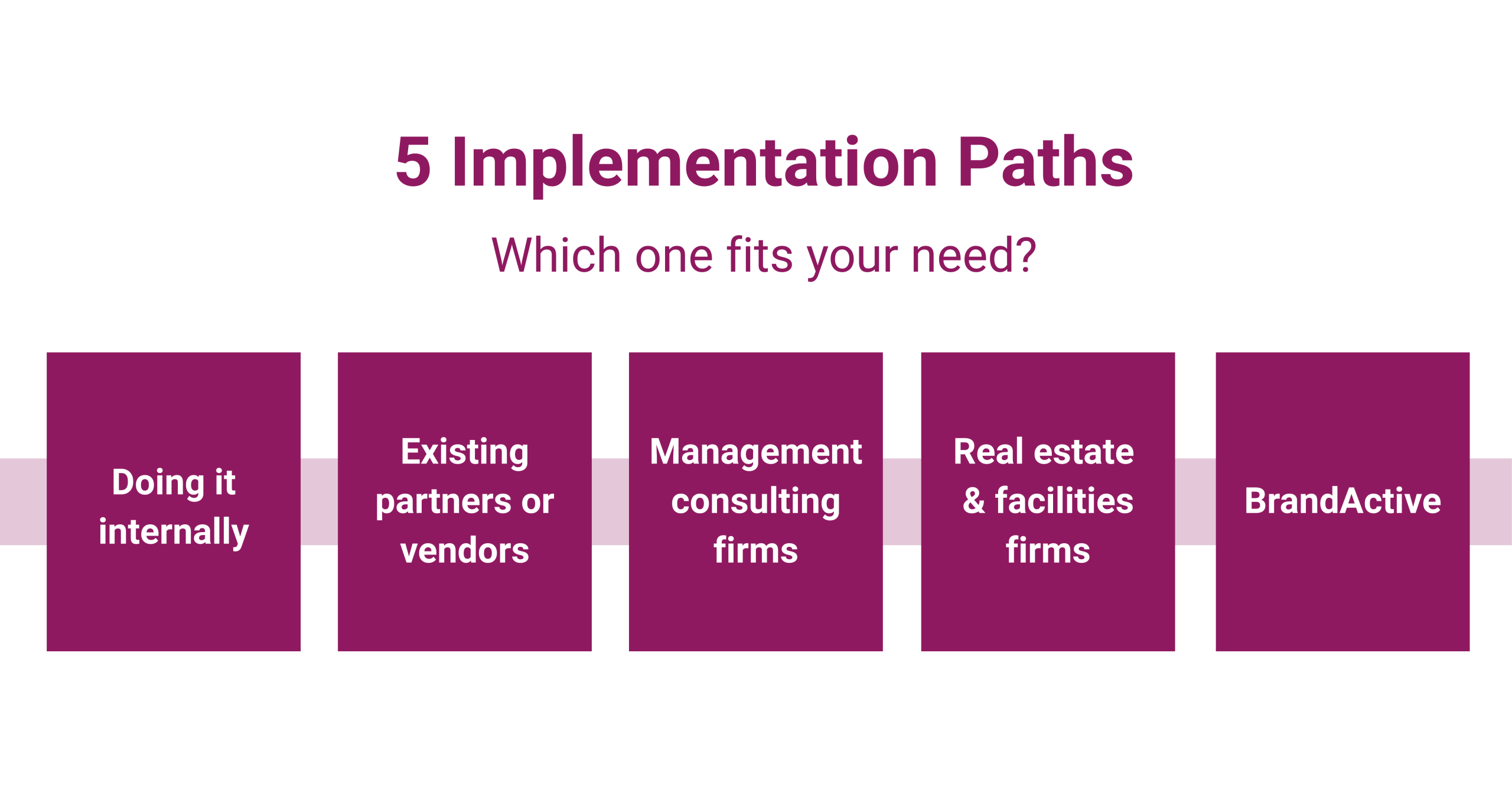
So, as you look at the program before you, we wanted to provide some practical insights on all of these options so that you can select the right path forward for you based on your size, complexity, and asset profile. The truth is there’s no single best model. There’s only the best fit for your goals, budget, structure, resource availability, and risk tolerance.
That’s why we created this guide – to help you understand when these approaches can work and how. We’ve seen every approach succeed and many that fall short. Here’s how they really stack up.
Doing it internally
Strengths
Internal teams bring a deep understanding of your organization, people, and priorities. They know how decisions get made, which relationships matter, and how the brand is perceived from the inside. That context can be a powerful asset, and managing the rebrand internally can appear to be the most cost-effective option.
Limitations
To some, rebrand implementation can look deceptively simple on paper, but the reality is far more demanding. The opportunity costs of pulling people away from their day jobs, especially marketers at a critical moment for business growth, need to be carefully weighed. Even with strong brand ownership, implementation is rarely anyone’s full-time job.
It can be difficult to align stakeholders across departments, particularly when finance, legal, HR, IT, and compliance all play critical roles. Sometimes, companies will assign an internal project manager to take the lead, often someone from the PMO with deep IT experience. While these PMs are highly skilled in their domain, a rebrand is a very different type of initiative. It requires coordinating a wide range of operational, creative, and cross-functional workstreams, plus having asset-specific knowledge to optimize them for cost, quality, and experience, all of which are well beyond the scope of a typical IT program.
Without a structured roadmap, it’s easy to underestimate the true scope or overlook key dependencies. This creates risks of missteps, inaccurate budgets, overspending, delays, disjointed customer experiences, and costly rework. And because rebrands happen so infrequently, typically every 10 to 15 years, most teams lack a proven playbook, reliable benchmarks, or optimization best practices to guide decisions with confidence.
When this works best
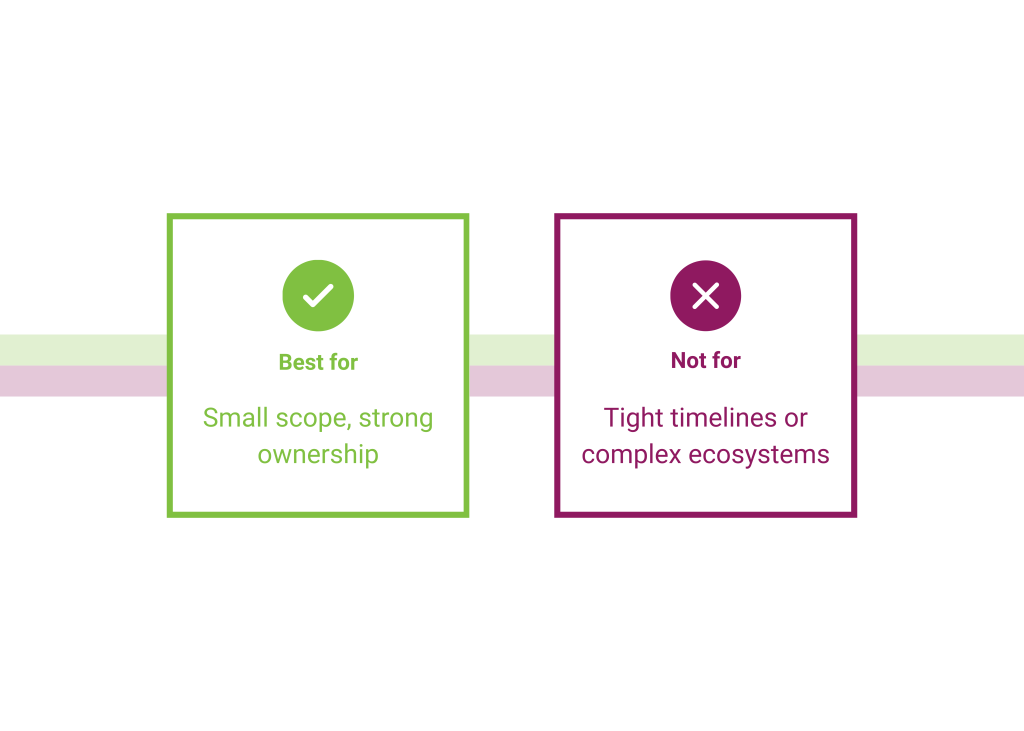
This approach can work well when the scope is limited, timelines are flexible, and internal resources have both the time and experience to lead the effort. In these cases, outside consultation may still be valuable in the beginning for providing structure, tools, or guidance to optimize the process and spend. If you’re going this route, we offer a limited number of complimentary implementation reviews each month to help internal teams stress-test their plans. It’s a simple way to uncover gaps early and move forward with more confidence. Just submit a Let’s Talk form to apply.
Existing partners or vendors
Strengths
Some firms whose core business is brand strategy, advertising, signage management, or branded environments, have added select implementation services to their portfolio. Because their primary expertise lies in their original discipline, they tend to approach implementation as an extension of that work rather than a dedicated or deep capability. If your rebrand is relatively straightforward and speed is the priority, this kind of vertical integration can make sense.
Your agencies know your brand, and they know how to create an impactful launch in areas like marketing, communications, events, and culture. Existing vendors know your landscape and assets, such as signage, but they aren’t strongly incentivized to optimize the costs of the implementation they own, although there are strategies to mitigate this. When timelines are tight and your implementation is mostly digital (agencies) or physical (vendors), they can be practical partners in moving the work forward. Their role is typically to gather input from your team and consolidate it into an execution plan, rather than provide a consultative, cost-reducing and data-driven partnership.
Limitations
While these firms are highly capable on the execution side (in fact, we often partner with such firms on specific deliverables), they’re typically not structured to lead the broader planning effort. Their focus is on implementing what’s already been decided, not on helping shape the implementation strategy behind it. They do not provide robust scenario planning, financial modeling or structured guidance to support internal alignment. And because they operate outside finance and operations, organizations are often left without clarity on cost trade-offs or governance needs. As a result, they’re not equipped to help avoid risks, lower costs, or build efficiency into the program. Even with strong execution, the risk is that organizations miss opportunities to integrate, optimize, and save time and money, resulting in wasted resources. We’ve seen clients enter these engagements expecting direction, only to receive a repackaged summary of inputs they or their teams had already provided.
When this works best
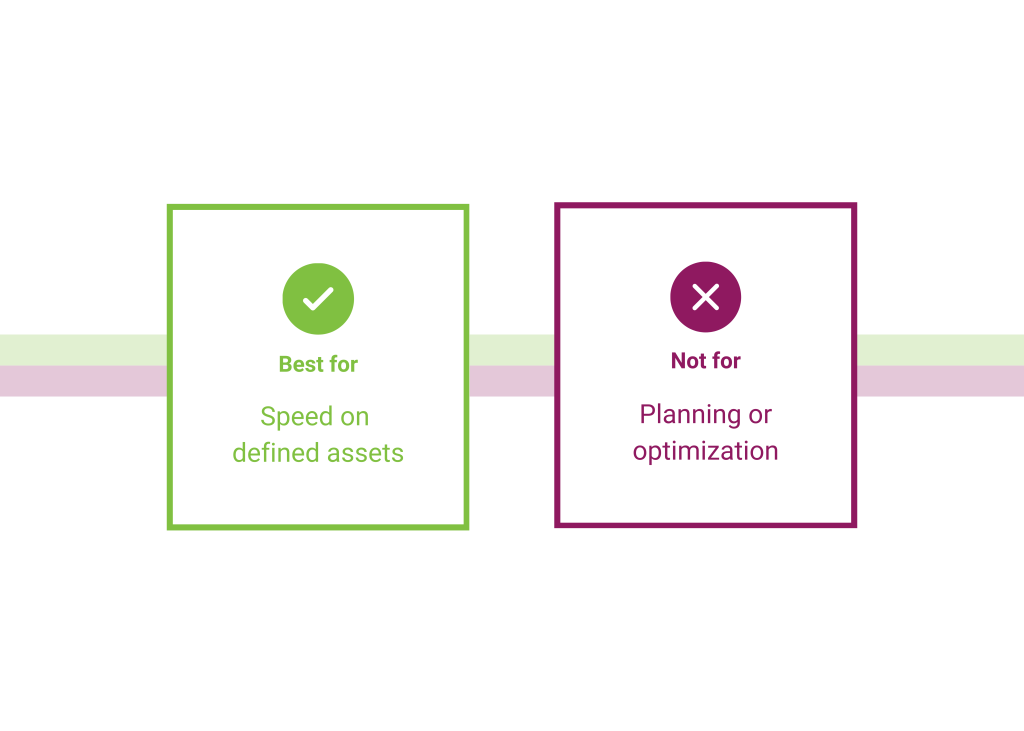
These firms can be a fit when the brand change is limited to select assets, and the internal team is prepared to manage strategy, governance, and communications. For organizations looking to move quickly on a defined set of deliverables, this model can be effective. But when brand change spans systems, touchpoints, and teams, a more experienced strategic partner is usually required.
Management consulting firms
Strengths
Management consulting firms bring structure, scale and experience leading complex organizational transformations, especially during mergers and acquisitions. They’re highly skilled at aligning systems and operations, standing up cross-functional workstreams, and guiding leadership through moments of organizational change. Many also have advertising or creative arms, which can make it even more enticing to consolidate work under one umbrella. For companies that already view them as trusted advisors, extending that relationship into brand implementation can feel like a natural next step.
Limitations
Despite their strengths, none specializes in integrated branded asset conversion and, as a result, brand workstreams often do not have a prominent place in the Integration Management Office. The focus tends to be on more of the organizational integration activities like IT, HR, facility and operations consolidations, while the assets within those areas and the dozens of branded asset areas that sit outside of those functions are left to operational leaders to plan and convert. This can lead to missed planning windows for asset updates, touchpoint misalignment, and a disjointed brand rollout, often without a clear budget or ownership. It can also put a company in a dangerous position of believing they were getting something more robust and more deeply tactical – putting them far behind the 8-ball when the deliverable is produced and the organization still needs to address all the things that need to be done in order to move forward. Without a brand-specific lens and deep technical asset conversion expertise, these firms lack the benchmarks and specialized data needed to accurately scope costs, allocate resources or anticipate operational risks.
When this works best
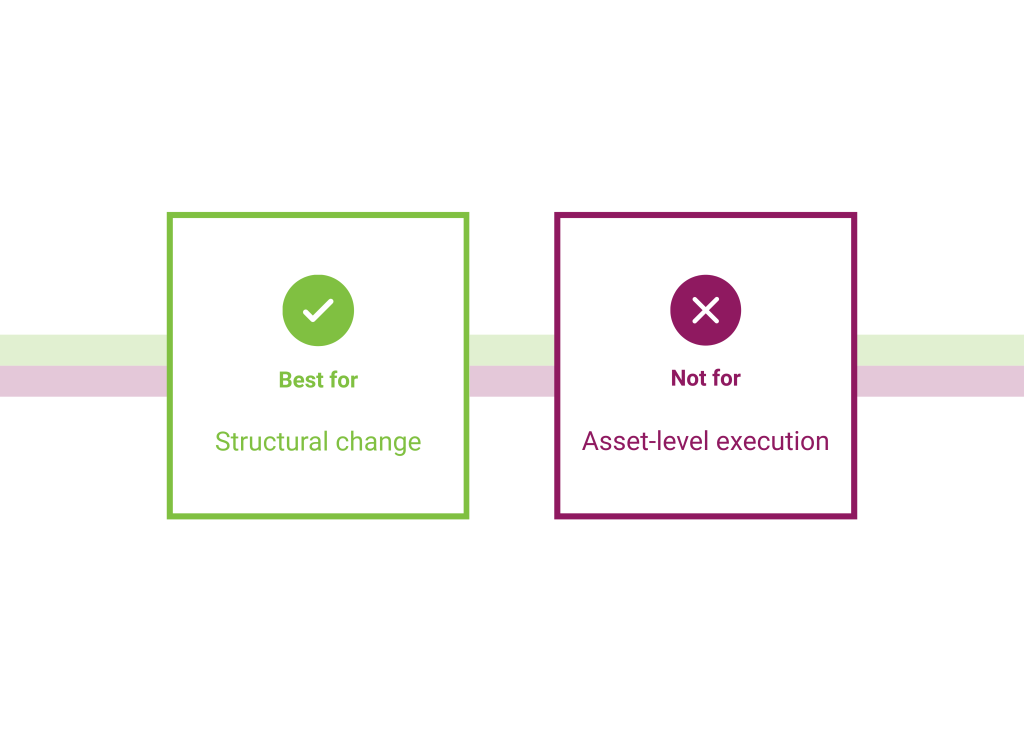
Management consulting firms are a good fit when the focus is structural or operational, and when a dedicated brand implementation partner is engaged to ensure the customer and employee experience is aligned throughout the change. There is a reason that great firms like Bain, Booz Allen, and Kearney have hired us to lead the implementation for their own brand transitions, recognizing that brand requires a distinct set of tools, expertise, and operational rigor. We’ve also been engaged by their clients during major integrations to identify branded assets, build cost models, and manage brand rollout alongside broader transformation efforts. These firms continue to be exceptional partners and we’re at our best when working alongside them to ensure brand is fully embedded into the change process.
Real estate & facilities firms
Strengths
Real estate firms are often involved in physical site logistics. They may already manage your facilities, and you may engage them to manage move coordination, signage replacement, and facilities planning with speed and scale. We work with them and have even supported their own rebrands. They are great facilities management organizations, highly effective when it comes to executing on-site logistics, and ensuring vendors can get the job done.
Limitations
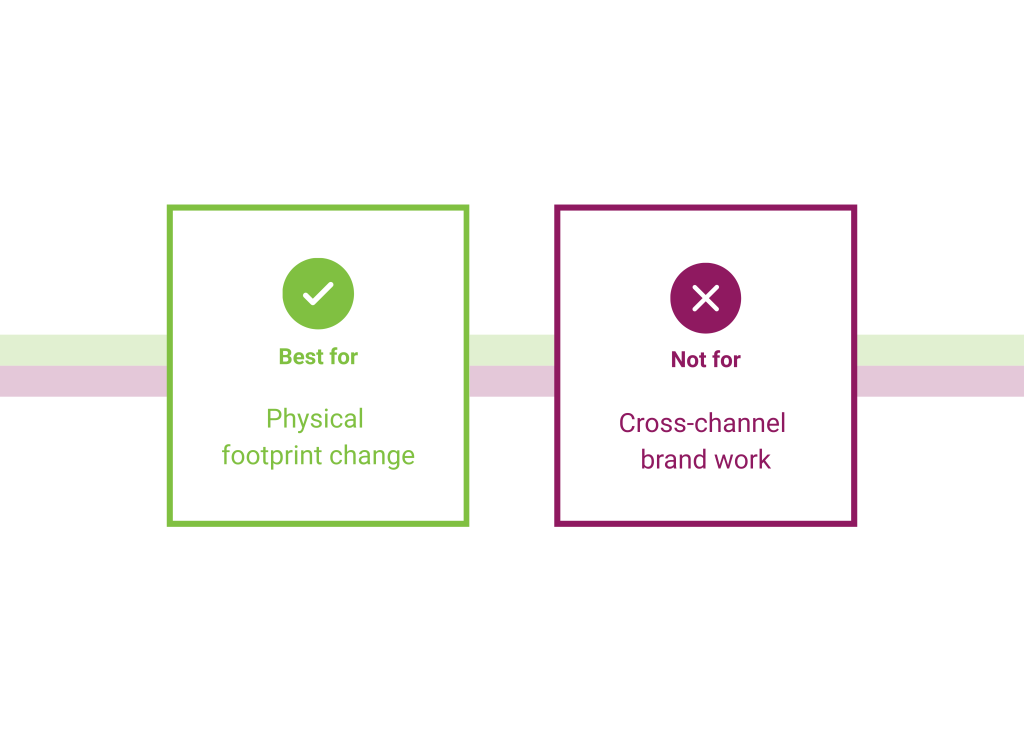
While these firms are strong partners for physical readiness, their focus is typically limited to site-level execution. Optimizing a roll-out across all facilities from a cost, speed, and quality perspective is not their strongest capability. Additionally, elements like branded digital assets, products and accompanying documentation, marketing collateral, HR materials, internal templates, and broader brand governance fall outside their scope. They may provide some visibility into signage costs but typically aren’t positioned to optimize them or manage brand-related spending across functions, especially when brand touches multiple departments, systems, and channels.
When this works best
This approach works well when the rebrand is primarily driven by a real estate event, such as a relocation or site consolidation, and when the organization has the internal structure to manage broader brand alignment separately. These partnerships work best when complemented by a team that can look holistically across the brand experience and synthesize that into a cohesive plan that doesn’t leave the organization spending more than is necessary or battling legacy logos for years to come.
BrandActive
Strengths
BrandActive exists for the moments when brand change can’t afford to go wrong: during rebrands, mergers and acquisitions, and enterprise-wide transformations where every system, location and team is impacted. These are the moments when the challenge isn’t just creative but operational, financial and organizational, cutting across geographies, functions and timelines. And they’re the moments that carry real risk: significant investment, tight deadlines, and high visibility with employees, customers, and the market.
With experience from more than 1,100 projects since 1998, we bring proprietary benchmarking data and proven playbooks that give clients clarity, efficiency, and confidence. We work across the full brand ecosystem, managing physical and digital branded touchpoints, internal and external experiences, and near-term execution with long-term strategy. What sets us apart isn’t just what we do, it’s how we do it. Through structured governance, transparent financial modeling, and deep cross-functional coordination, we help organizations reduce risk, accelerate alignment, and move forward faster. Our work spans rebrand implementation, change management, operational brand governance, wayfinding, and marketing and brand operations, all to support organizations through the full brand implementation and management lifecycle.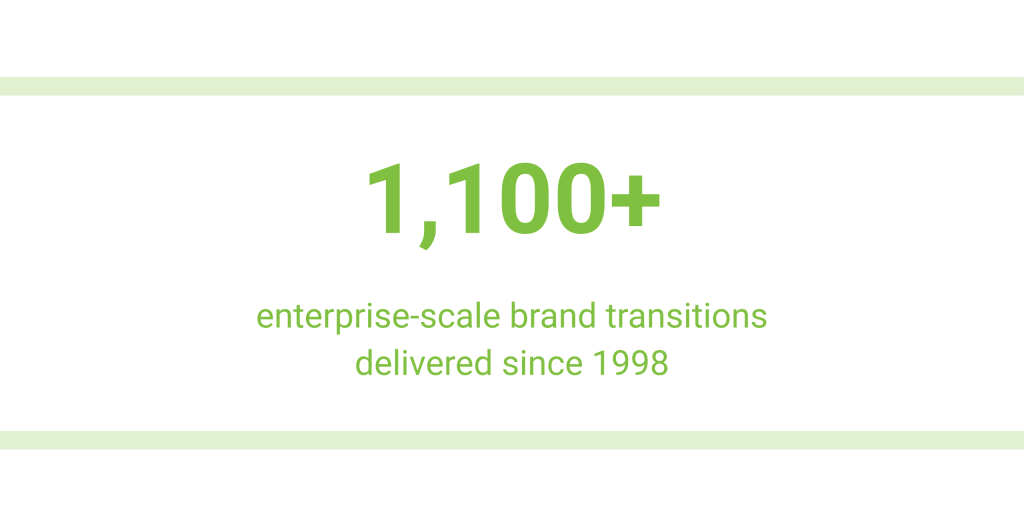
Limitations
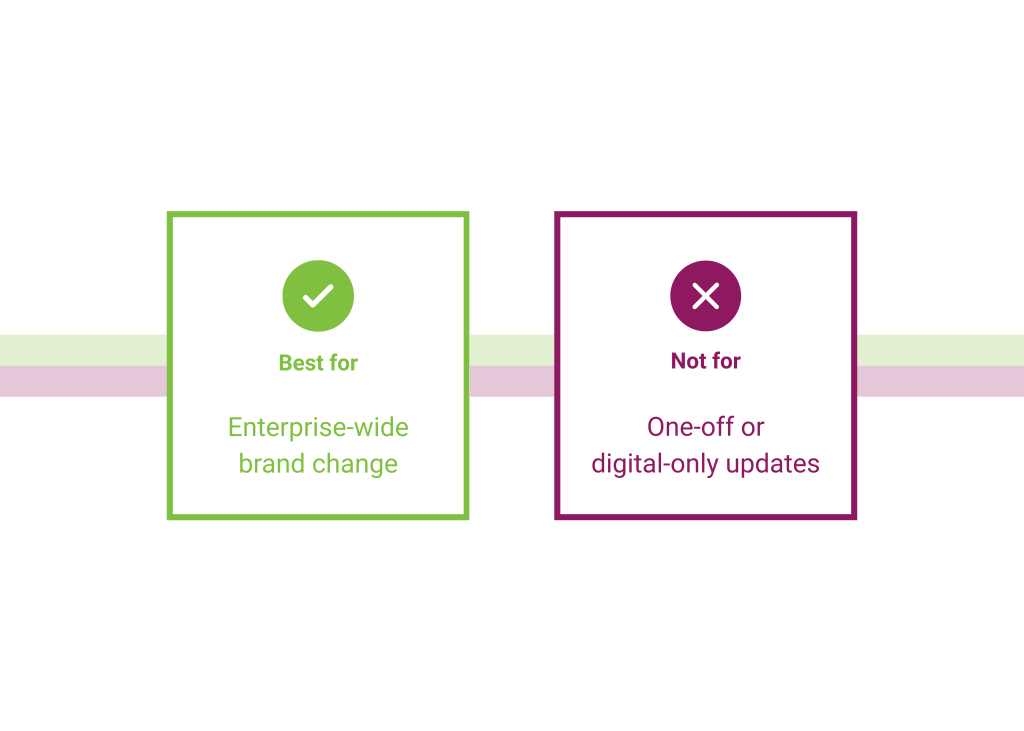
Our approach is best suited for organizations managing large-scale change, not one-off signage projects, mostly digital transformations or brand updates that don’t require broad internal alignment. We typically support companies with 25+ locations, 1,000+ employees, or $500M+ in revenue, where brand touches multiple functions, business units, or systems. While we’re built for scale, we’re not the right fit for organizations looking for tactical support without strategic optimization and coordination. The brands we work with often come from complex, regulated, or asset intensive industries including healthcare, pharmaceuticals, medical devices, life sciences, financial services, manufacturing, energy, utilities, telecommunications, professional services, higher education, and technology.
When this works best
We’re most often called in when the stakes are high: during mergers, major rebrands, or brand operationalization efforts that span systems, locations, and departments. Clients who bring us in to work alongside their teams and partners right at the moment they believe brand change is on the table often avoid rework, reduce spend, and build internal alignment faster. And those who’ve worked with us once tend to bring us back when the next brand change comes.
Want to talk through your options?
Choosing a partner is less about checking a box and more about finding the right fit for your organization, your goals, and your stage of change.
Whether you’re early in planning or midstream and need support, we’re happy to talk through what’s working, what’s not, and how to move forward with clarity.